Indian military sources said no firearms were used in the clashes and that most of the injuries were sustained following stone-pelting and use of rods by the Chinese side.
Singh said a meeting between senior Indian and Chinese military leaders has been scheduled for June 6 even as he asserted that India is not going to back off from its position. Asked about the current situation in sensitive areas in eastern Ladakh, he said Chinese have come up to what they claim is their territory while Indians believed it is theirs.

Defence Minister Rajnath Singh on Saturday asserted that the government will not allow India's pride to be hurt under any circumstances even as he said bilateral talks were on at military and diplomatic levels to resolve the row.
The Indian Army will continue to maintain its aggressive posturing in all disputed areas in eastern Ladakh and will not back off till status quo is maintained, sources said.

'India's move has grossly violated China's territorial sovereignty, seriously violated relevant agreements, protocols and important consensus reached between the two countries'
The commanders will also deliberate on the overall situation in Jammu and Kashmir besides delving into issues having national security implications, they said. However, the main focus will be on the situation in eastern Ladakh where Indian and Chinese troops are locked in an eyeball-to-eyeball face-off in Pangong Tso, Galwan Valley, Demchok and Daulat Beg Oldie, the sources said.
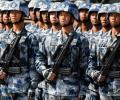
With the Indian Army having blocked the PLA several kilometres inside India, hundreds of soldiers from both sides remain in a tense face-off.
The 60-metre bridge is around four kilometres east of the confluence of Shyok and Galwan rivers, and links the narrow mountainous region to the Shyok-Daulat Beg Oldi road.
It is learnt that the India's top military brass is constantly monitoring the evolving situation even as the United States said the aggressive behaviour by Chinese troops was a reminder of the threat posed by China.

'This was Indian land the PLA advanced on and occupied.' 'The Chinese then 'negotiated' a pullback of their troops a small distance on Indian territory even as Indian jawans draw back further into India from the forward position.' 'An apparently satisfied Indian government says this is a great move for peace! How great is that for China!'
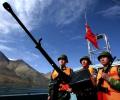
Both the Indian and Chinese armies have brought in more troops in sensitive locations like Demchok, Daulat Beg Oldie and areas around Galwan river as well as Pangong Tso lake in Ladakh, the sources said. The area around Galwan has been a point of friction between the two sides for over six decades.

Indian Army officers are convinced China is maintaining the pretence of dialogue and negotiations in order to create the opportunity to occupy more Indian territory. Senior Indian planners apprehend this might be a Chinese ploy to divert attention from Depsang, in Northern Ladakh, which might be China's actual target.
The MEA spokesperson did not reply to questions like whether the US had approached India with the offer, whether New Delhi has communicated its response over it to Washington, DC or whether the Trump administration has been briefed about the current standoff between Chinese and Indian soldiers in eastern Ladakh.

At least a couple of Chinese military helicopters were spotted flying close to the un-demarcated Sino-India border in the area after the fierce face-off on May 5 following which a fleet of Sukhoi-30 jets of the Indian Air Force too carried out sorties there, the sources said.
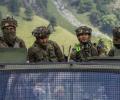
India and China on Saturday held another round of military talks with a focus on taking forward the disengagement process in Hot Springs, Gogra and Depsang in eastern Ladakh and bring down the tensions in the region, official sources said.

The sources said the soldier was handed back to China at the Chushul-Moldo border point in eastern Ladakh at 10.10 am.
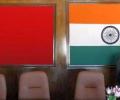
The sources said the focus of the talks was to take forward the disengagement process in friction points like Hot Springs, Gogra and Depsang in eastern Ladakh.

He said there were no signs of an "overt collusion" between China and Pakistan during the Ladakh standoff but India also caters to a long term strategy for not a two, but a two-and-half front war. With the half front, he was referring to the internal security.
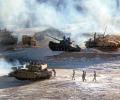
'We must be careful because China has not given its design in Eastern Ladakh.'

'The military advantage the Indian Army had gained by the Special Frontier Force occupying the heights of the Rezang La-Rechin La ridge on the Kailash Range is lost without the PLA withdrawing to east of the Khurnak Fort line.'
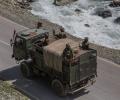
The strengthening of the Mountain Strike Corps is part of the steps taken by the force to rebalance its focus more towards the Chinese border from the western front with Pakistan.
The US hopes that the differences will be resolved peacefully, officials said in Washington.
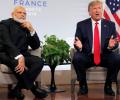
Trump on Wednesday said in a tweet that he was "ready, willing and able to mediate" between the two countries.

The talks between India and China on the border row in eastern Ladakh have helped 'build trust' and the situation in the region has been normal since the disengagement in the Pangong Tso areas in February, Chief of Army Staff General M M Naravane said on Thursday, exuding confidence of resolution of the 'remaining issues'.

After rallying 543 points in the morning session and touching the 40,000-mark, the BSE Sensex surrendered all gains to close at 38,628.29, showing a loss of 839.02 points or 2.13 per cent. Similarly, the NSE Nifty tanked 260.10 points or 2.23 per cent to end at 11,387.50.

After a gap of over two-and-half months, India and China on Sunday held the ninth round of military talks specifically focusing on ways to move forward on the long-negotiated disengagement process in eastern Ladakh as thousands of their troops remained deployed at friction points under freezing conditions.
The comments came in the backdrop of the continuing standoff between the militaries of India and China at the LAC.
The MEA said it was the Chinese side that recently undertakook activities hindering India's normal patrols in the areas.
There was no comment from the Indian side on the statement made by the Chinese defence ministry spokesperson Colonel Wu Qian, and carried by China's official media.
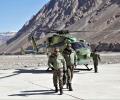
'This reluctance to respond forcefully to Chinese PLA provocations and outright aggression has as much to do with Prime Minister Modi personally, as with the institutional mindset of the MEA or even the Indian Army.' 'They are scarred by the 1962 War and are still cowed by China.'
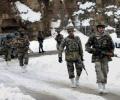
'The Chinese have been moving in step by step; inch by inch for the last 40 years.'

Under the India-China agreement on the disengagement process in eastern Ladakh, the Chinese army will pull back its troops to east of Finger 8 areas in the northern bank of Pangong lake, Defence Minister Rajnath Singh said in Parliament on Thursday, in what is seen as a significant step to dial down tensions in the key face-off site.
'I strongly urge China to respect norms and use diplomacy and existing mechanisms to resolve its border questions with India'
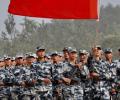
The Chinese action followed 'India's recent, illegal construction of defence facilities across the border into Chinese territory in the Galwan Valley region', a write-up in the state-run Global Times tabloid said, quoting unnamed military sources.
'The Indian Army's surveillance had noticed the Chinese movements.' 'There was no intelligence failure.'
The sources said both sides held extensive deliberations on modalities for disengagement of troops from all the friction points in eastern Ladakh at the talks.

China said that after this incident both sides are in communication and coordination on the matter through diplomatic and military channels.
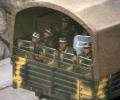
The intrusions into India were likely carried out by the PLA's better trained and equipped 'mobile operational units'.
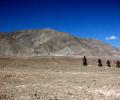
While the de-escalation process was underway, a violent face-off took place on Monday night between Indian and Chinese troops leading to the death of 20 Indian soldiers.
On May 5, around 250 Indian and Chinese army personnel clashed with iron rods, sticks, and even resorted to stone-pelting in Pangong Tso lake area in Eastern Ladakh.
